
T1 and T2: The Minute Most Triathletes Give Away
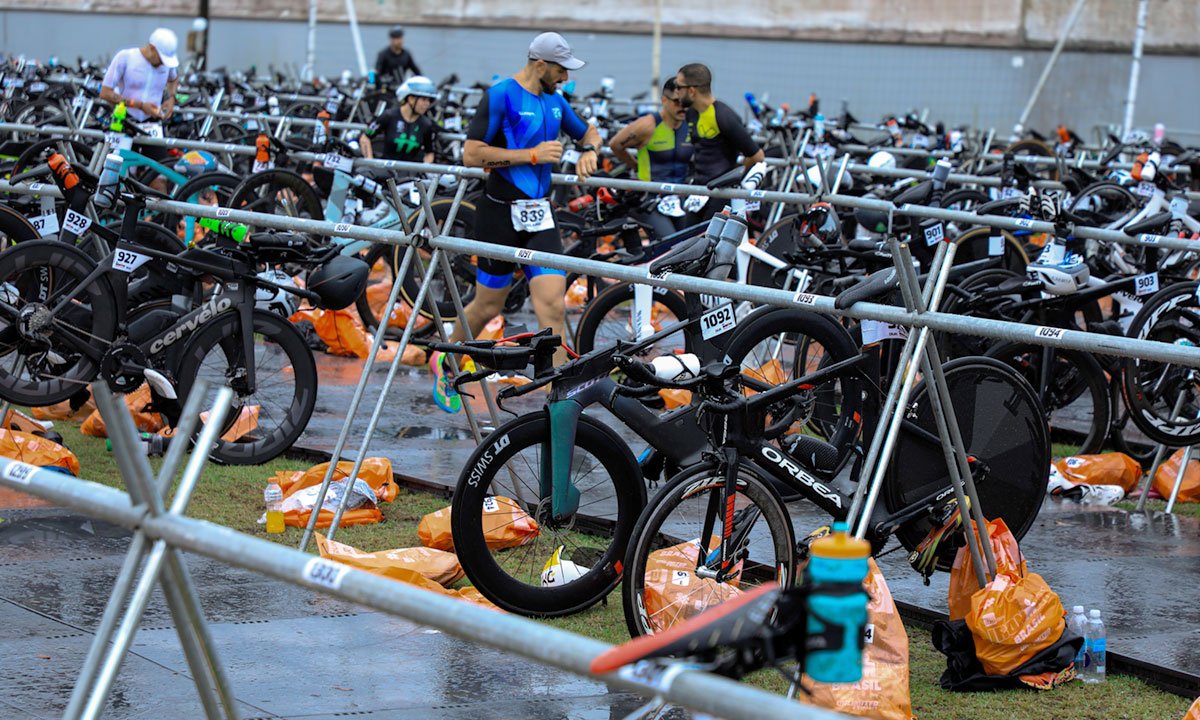
You train swimming, biking and running. The transition zone gets practised once before race day, if at all. That is where most time actually disappears: not out on the course, but between disciplines, when your hands are shaking with adrenaline and you are trying to find your own bike in a row of a hundred identical ones.
Stępniak gained over 20 seconds in transition
The theory about the “fourth discipline” sounds fine until you see the numbers.
At IRONMAN 70.3 Kraków, Poland, in 2026, Kacper Stępniak won by 20 seconds over Daniel Baekkegaard. The official splits show where that margin came from:
Transition times at IRONMAN 70.3 Kraków 2026 Bar chart of T1 and T2 for the top ten men. Winner Kacper Stępniak has the shortest of both transition zones. Transition times, IRONMAN 70.3 Kraków 2026 Top ten men. The winner had the shortest T1 and the shortest T2 of the whole field. T1 T2 0:00 1:00 2:00 3:00 4:00 5:00 6:00 1. Stępniak 2:48 1:21 4:09 2. Baekkegaard 3:09 1:22 4:31 3. Dubrick 2:51 1:37 4:28 4. Krawczyk 3:00 1:36 4:36 5. Vogel 2:53 1:40 4:33 6. Butters 3:07 1:45 4:52 7. De Keyser 2:51 1:33 4:24 8. Lukatsch 2:56 1:24 4:20 9. Derrett 3:07 2:05 5:12 10. Boettinger 3:08 1:38 4:46 Stępniak won the race by 20 seconds, and gained 22 seconds on the runner-up in the transition zones.Stępniak had the shortest T1 and the shortest T2 of the entire top ten. He spent 4:09 total in the transition zones, the Dane 4:31. The difference: 22 seconds, against a finish-line margin of 20.
In other words, Baekkegaard was marginally faster out on the course. The Pole won this race at the rack.
How long it actually takes
There is a common claim that professionals clear T1 in twenty seconds. That is true only in draft-legal short-course racing, where there is no wetsuit to strip and the bike sits a few steps from the water. On the distances most age-groupers race, the numbers look completely different.
| Who and where | T1 | T2 |
|---|---|---|
| PRO, 70.3 Kraków 2026 (top 10) | 2:48-3:09 | 1:21-2:05 |
| PRO, full IRONMAN Texas 2026 (top 5) | 1:59-2:56 | 1:41-2:25 |
| Age-grouper, average | 2-4 min | 1.5-3 min |
| Age-grouper at a big-brand 70.3 | realistically 3-5 min per zone | |
| Beginner | 5-7 min | 2-4 min |
Look at the second row. Transition times at the full-distance IRONMAN were shorter than at the half in Kraków, the opposite of what intuition suggests. Transition time is set by the layout, the length of the run from the water and the conditions, not by race distance. Comparing your T1 to someone else’s from a different race tells you nothing.
Where you actually lose time: it is not T1
Among the top ten men in Kraków, the spread was:
- T1: 21 seconds between the fastest and the slowest
- T2: 44 seconds, more than double that
T1 looks dramatic because it has the wetsuit, the disorientation after exiting the water and the longest run to the rack. But everyone loses roughly the same amount of time there. The differences show up in T2, a zone that looks simpler: get off the bike, rack it, change shoes, run out.
The same pattern holds for the women, though less pronounced: a 36-second T1 spread, 39 seconds for T2.
The practical takeaway: if you only practise one zone, practise T2. It is shorter, simpler, and it is where athletes at the same level differ the most.
Before you race: scout the zone
Before laying out your gear, walk the route on foot: from the water exit to your spot, and from the bike dismount to the run exit. Count the rack rows from the entry and exit points.
This needs to work under race-day stress, when your head works worse than it does in training, so count concrete landmarks: a tent, a banner, the end of a fence. “Somewhere in the middle on the left” will not work.
How to lay out your spot
Transition rack setup Diagram of a rack spot: bike hung by the saddle, bike gear on one side of the wheel, run gear on the other. T1 and T2 move order marked. How to lay out your spot Bike gear on one side of the wheel, run gear on the other. Less ground to search under pressure. rack saddle on the rack A Bike side helmet (strap open, ready) bike shoes goggles tucked in the helmet gel for the first kilometres B Run side run shoes, laces elastic, not traditional cap and race belt with number gel for the run one wheel separates the two sides T1, water to bike 1. wetsuit down to the waist while still running → 2. sit, pull it off your legs → 3. helmet on and strap fastened → 4. only now take the bike off the rack T2, bike to run 1. dismount before the line → 2. hang the bike by the saddle → 3. only now take off the helmet → 4. shoes on and run outOrganisers usually ask athletes to rack bikes in alternating directions, front wheel one way then the other, so two athletes can share the same stretch of rack without getting in each other’s way.
Lay gear out with bike items on one side of the wheel and run items on the other. It sounds obvious, and it cuts in half the area you have to search under pressure.
T1: water to bike
Start unzipping the wetsuit while still running out of the water. Pull the top down to your waist before you reach your spot. Push your goggles and cap up onto your forehead rather than pulling them off straightaway, so your hands have something to do while you work the zip.
At your spot: sit down, pull the wetsuit off your legs, put the helmet on and fasten the strap before taking the bike off the rack. The order matters, since riding off with an unfastened helmet is a disqualification under most rulebooks.
Mounting the bike with shoes already clipped into the pedals is a technique for someone who has drilled it dozens of times. Race day is not the place for a first attempt. The safer option: shoes on your feet in the zone, bike run to the mount line, and only then swing onto the saddle. If your shoes have stiff soles and cleats you cannot run in, the alternative is learning to mount barefoot and put the shoes on while riding.
T2: bike to run
This is where most of the time gets decided, as the numbers above show.
Dismount before the line, not on it. Walk or run the bike to the rack, hang it by the saddle, and only then take off the helmet. The rule runs opposite to instinct: keep the helmet on until the bike is safely racked.
Elastic laces instead of traditional ones on the run shoes are the easiest second to buy in the whole sport. Tying a knot with shaking fingers can cost more time than the rest of the zone combined.
Legs often feel numb after getting off the bike, and that is normal. If they feel unsteady, a few steps of walking before you switch to running is not wasted time, it is insurance against a fall in the first kilometre.
Details that buy seconds
Plastic bags over the feet and hands make it easier to pull the wetsuit on before the start. A wetsuit sleeve pulled over the watch saves fighting with the strap when stripping it off. It is worth creasing the race number by hand before the event: a stiff card flapping in the wind is more distracting than it sounds.
Train it like training, not like laying gear out in a garage
Laying gear out on a mat in the garage teaches nothing. Transition practice only means something with an elevated heart rate, right after exiting the water or getting off the bike, because that is exactly the state you will be in on race day.
Add a mini transition to brick sessions: after an open-water swim, run through the real sequence of stripping the wetsuit and putting on the helmet before getting on the bike. A few repetitions in the months before the race, and on race day your hands will know what to do even when your head refuses to cooperate.
The twenty-two seconds Stępniak gained at the rack were not a matter of talent. They were the result of having done that same movement hundreds of times before.