
How to Choose a Triathlon Saddle That Actually Works
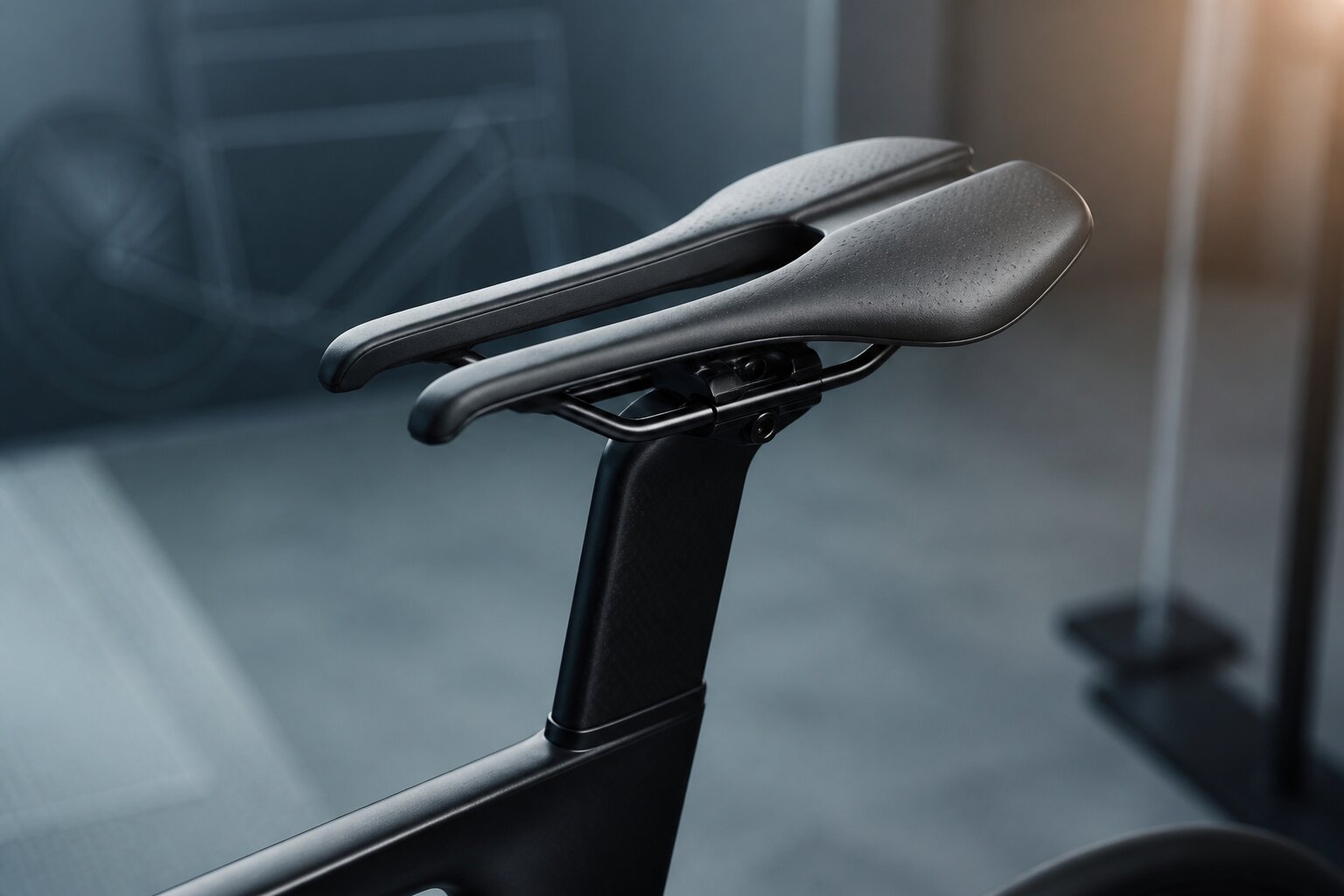
Numbness in your crotch after an hour in the aerobars is not “the price you pay.” It is a sign that the saddle is cutting off blood flow. In a triathlon position you rotate your pelvis hard forward and put your full weight on tissue that was never built to carry it. The right saddle solves this, provided you know what to look for.
Why a standard road saddle is not enough
A classic saddle is designed for an upright position, where you sit on your sit bones. Lay yourself out on the aerobars and the pelvis rotates forward, loading the pubic rami and the soft tissue of the perineum, where the nerves and blood vessels run. The result is numbness, pain and, over time, real problems.
This is where triathlon-specific designs come in. Brands such as ISM popularised the split-nose design, a saddle with the nose split or removed entirely. Research into tissue oxygenation in cyclists shows the scale of the problem: on a traditional saddle, oxygen supply to perineal tissue can drop by several dozen percent, while on saddles without a conventional nose the drop is far smaller. In studies by NIOSH researcher Dr Steven Schrader, the figure was around 20 percent against more than 70 percent on a standard saddle. The mechanism is simple: the weight rests on bone, not on sensitive tissue.
Three schools of design
Noseless, twin arms (ISM). Instead of a traditional nose, ISM fits two independent arms. The best known model is the ISM PN 3.1, often praised as a universal choice. The ISM PS 2.0 variant has a slightly raised rear that gives extra hip support in a deep rotation. It suits riders who feel pain at the front of a normal saddle within a few minutes.
Short nose with a wide channel (Specialized Power). Keeps the nose but shortens it and cuts a wide, long channel down the full length. It became a bestseller across every discipline precisely because it pairs comfort with versatility: you can ride it on a road bike too.
Full split from nose to tail (Bontrager Hilo, Cobb). The most triathlon specific of the lot, with a complete cutout running the full length. Built for athletes who spend most of their training time in the aero position.
What it costs
Prices depend on the rail material, steel, titanium or carbon, and the retailer. For US buyers, the manufacturers’ own prices for these models:
| Model | Type | Price |
|---|---|---|
| Specialized Power Expert | short nose, channel | $159.99 in the US |
| ISM PS 1.0 | noseless, twin arms | $239.88 in the US |
| ISM PN 3.1 | noseless, narrow arms | $229.88 in the US |
| Bontrager Hilo | full split | varies by Trek distributor; the Comp variant lists at $119.99 in the US |
These are reference prices. Check current listings before buying, since they shift with rail spec and running promotions.
The golden rule: test before you buy
A saddle is the most personal component on a bike. What works for a training partner can be torture for you. Your anatomy, the width of your sit bones and the angle of your pelvic rotation are unique. So:
Use a demo programme if one is available. ISM ships a demo saddle for the retail price plus a one-off $20 shipping charge, refunded if you keep it, and gives you 30 days on the bike. Specialized runs a comparable ten-day trial, and mail-in services such as Bike Saddle Box hold dozens of models across brands. Plenty of fitters and local shops rent saddles by the week too, crediting the fee against a purchase.
Best of all, fit the saddle during a bike fit. A pressure-mapping mat shows where excess load builds up, and 3D motion analysis shows how the pelvis behaves at different settings. The saddle alone does nothing if your seat height and setback are wrong. A new saddle usually means a new height setting too: noseless designs are typically mounted slightly lower.