
Torso Rotation in Front Crawl: Swim Less Flat
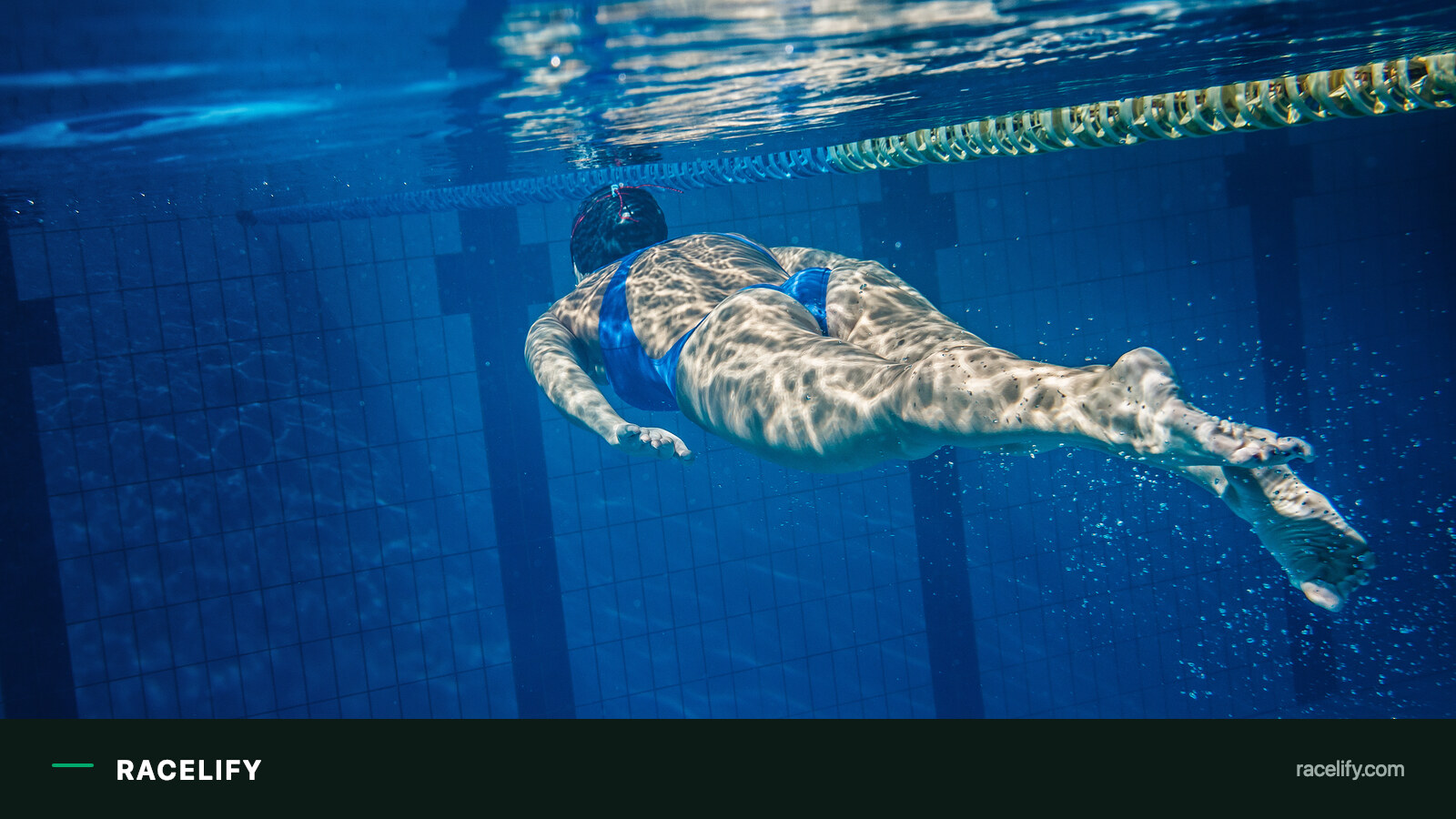
Most amateur triathletes swim front crawl flat: chest glued to the surface, the stroke driven by the arms alone. The result is a short, jerky pull, overloaded shoulders, and a pace that refuses to move no matter how many hours go into the pool. One thing is missing: torso rotation. It turns swimming from tiring arm-waving into a long, efficient glide.
What rotation actually does
When you rotate the torso around the body’s long axis, you bring the lats and the core into the work, alongside the shoulders and arms. The underwater pull gets longer, because the arm reaches further on entry and the hip adds force to every stroke. It is like rowing with the whole body instead of the forearm alone.
Rotation gives three concrete benefits: a longer stroke (fewer cycles per length), a lower risk of shoulder overload, because the force comes from the big muscle groups, and easier breathing, since the mouth clears the water on its own during the turn instead of you having to crane the neck.
How much to rotate, and when it is too much
This is not about rolling side to side like a log. Aim to rotate both hips and shoulders together, enough that the body is clearly on its side but still moving in a stable line. Coaches quote different numbers here, most commonly around 30 to 45 degrees to each side (some technique schools go lower), and the exact range is individual. What matters is that both sides rotate evenly: rotate hard only toward your breathing side and you become asymmetric, drifting into a zigzag.
Too much rotation is also a mistake. Roll almost onto your back and you lose balance, the legs drop, and the whole body brakes. The target is enough to engage the torso, and no more than that, so the water line stays intact.
Three common mistakes
- Rotating from the shoulders, not the hips. You twist the arms while the hips stay flat. Force never travels through the torso, and the spine takes the twist instead. Start the rotation from the hips; the shoulders follow.
- Snaking. Uneven rotation combined with crossing the hand over the body’s centreline sends you swimming in a sine wave. It adds distance and burns energy on correcting course.
- Rotation that stalls on the breath. Many swimmers freeze on their side waiting to inhale. The breath should be part of the continuous rotation, not a pause in it.
Four drills that fix it
- 6-3-6 (six-kick switch). Swim on your side with one arm extended forward, the other at the hip, face down. Six kicks on one side, three strokes, six kicks on the other. Teaches balance on the side and a controlled transition through the rotation.
- Side kick, with or without a board. On your side, lower arm extended, kicking while holding a stable position. You feel how to balance the body in rotation without panicking.
- Fingertip drag with a hip cue. The classic fingertip drag on the recovery, but you consciously start each stroke from a hip rotation. It links a high elbow with rotation.
- Single-arm swimming. Swim with one arm, the other extended forward or resting at the hip. Without the other arm to help, torso rotation has to drive the stroke, and the flaw shows up immediately.
Use these as a warm-up or work them into a technique set two to three times a week. Technique does not improve from one session; it needs repetition until the new pattern becomes a habit.
Taking it to open water
In open water, rotation works even harder in your favour. A stable balance helps you hold a line through chop, and a smooth rotation makes it easier to combine breathing with sighting. A swimmer who rotates evenly on both sides can breathe to either side, which is invaluable when the sun or the swell is hitting you from one direction.
Try one thing at your next session: count your stroke cycles per length, correct the rotation from the hips, then count again. If the number drops at the same pace, that is proof it works.