
Single-Leg Drills: Do They Really Make You a Faster Cyclist?
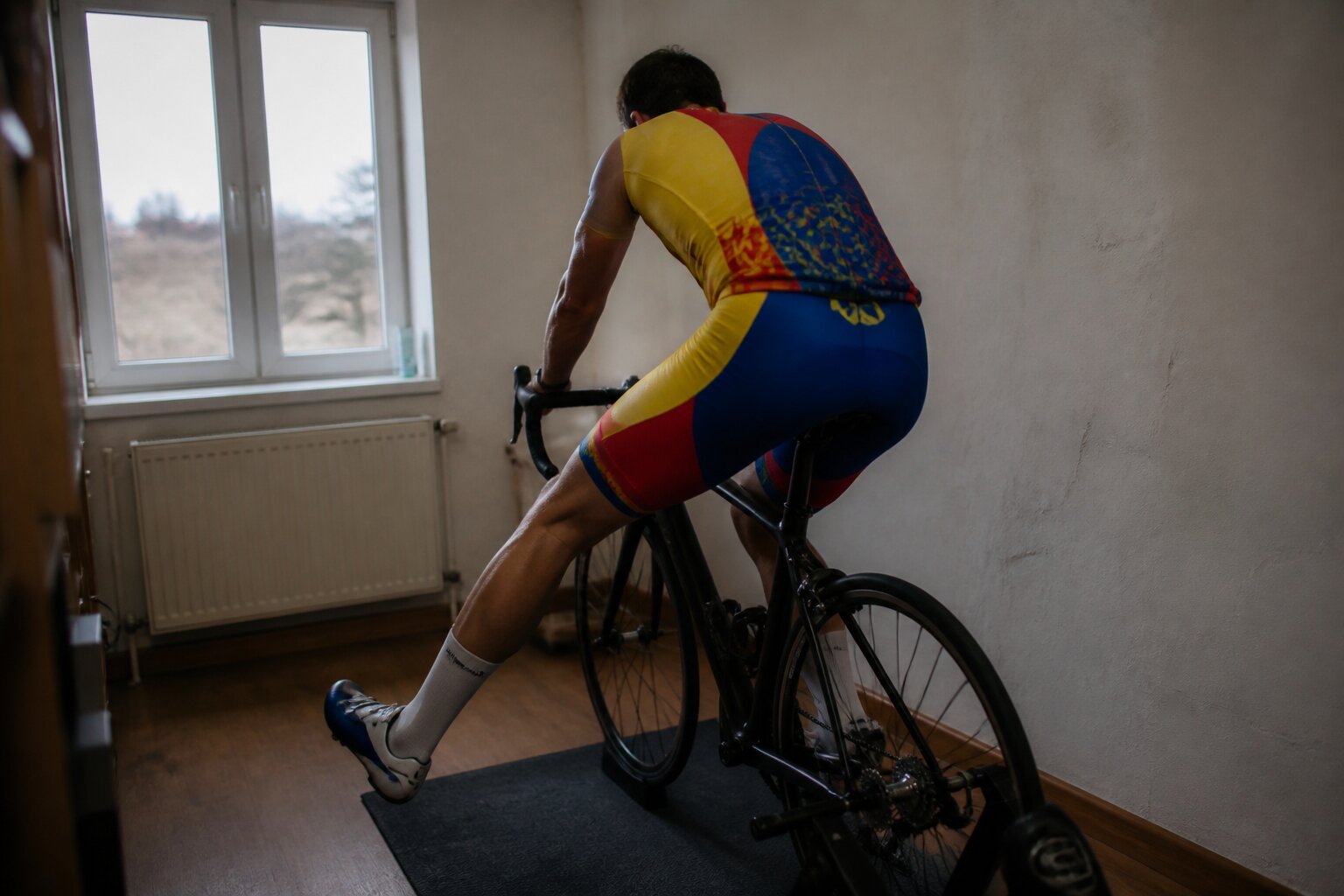
Step onto the trainer, unclip one foot, and spin the other leg for a minute. It sounds trivial, and after 40 seconds the leg is burning and the pedal stroke stops looking like a circle and starts looking like a square. The single-leg drill is one of the most commonly recommended cycling technique exercises. The question is whether it actually improves anything, or whether it’s just a good-looking warm-up ritual.
What the drill actually improves
Start with an honest distinction. The single-leg drill will not add tens of watts or raise FTP on its own, it does not replace intervals. It works on something else: neuromuscular feel and smoothness of the pedal stroke.
It also needs to be said plainly: there is little hard scientific evidence that technique drills actually improve cycling economy or performance. Controlled studies on the topic are scarce, and the ones that exist do not show clear benefits. So the single-leg drill is best treated as a tool for working on feel and technique, not a proven way to ride faster.
Pedalling with one leg makes the dead spots immediately obvious, the top and bottom of the stroke where the leg loses pressure and the rotation stalls. The other leg usually covers for it. In isolation there is nowhere to hide: the leg has to be guided smoothly through the whole circle, particularly unweighting the back of the stroke instead of just stomping down.
It can also work as a diagnosis. If one leg spins smoothly and the other jumps, that is a clear sign of an asymmetry worth addressing.
Watch out for the pulling up myth. Most power still comes from the downstroke, the point is not to aggressively yank the pedal upward, but to unweight the leg on the return and smooth out the dead spot.
How to do it well
The trainer is the best place for it: stable and safe. A practical protocol:
- Where: on a trainer, the resting foot propped on something like a stool alongside, or simply unclipped and set aside.
- Duration: start at 30 to 60 seconds per leg, building over time to 1 to 2 minutes.
- Sets: 2 to 4 reps per leg, ideally during a warm-up or an easy ride.
- Goal: a smooth, even stroke with no knocking. Picture scraping mud off the bottom of a shoe at the bottom of the stroke.
- Frequency: 1 to 2 times a week. It is an addition to training, not its core.
If after a dozen or so seconds the stroke turns into a jerky up-down sequence, that is a sign the drill is doing its job, and that there is something to work on.
Why it matters in triathlon
In triathlon, what matters is how much strength and reserve is left for the run, not power alone. A smoother, more economical pedal stroke means less wasted energy and an easier time holding an aero position over long distances. Working on a smooth stroke also helps hold a steady pace once fatigue starts to break technique down.
It is not magic, though. It is a tool for sharpening technique and feel, real watts still come from structured intervals and volume. The single-leg drill is an addition meant to make that power reach the pedals more smoothly.