
Race Simulation Training: Kill Start-Line Nerves
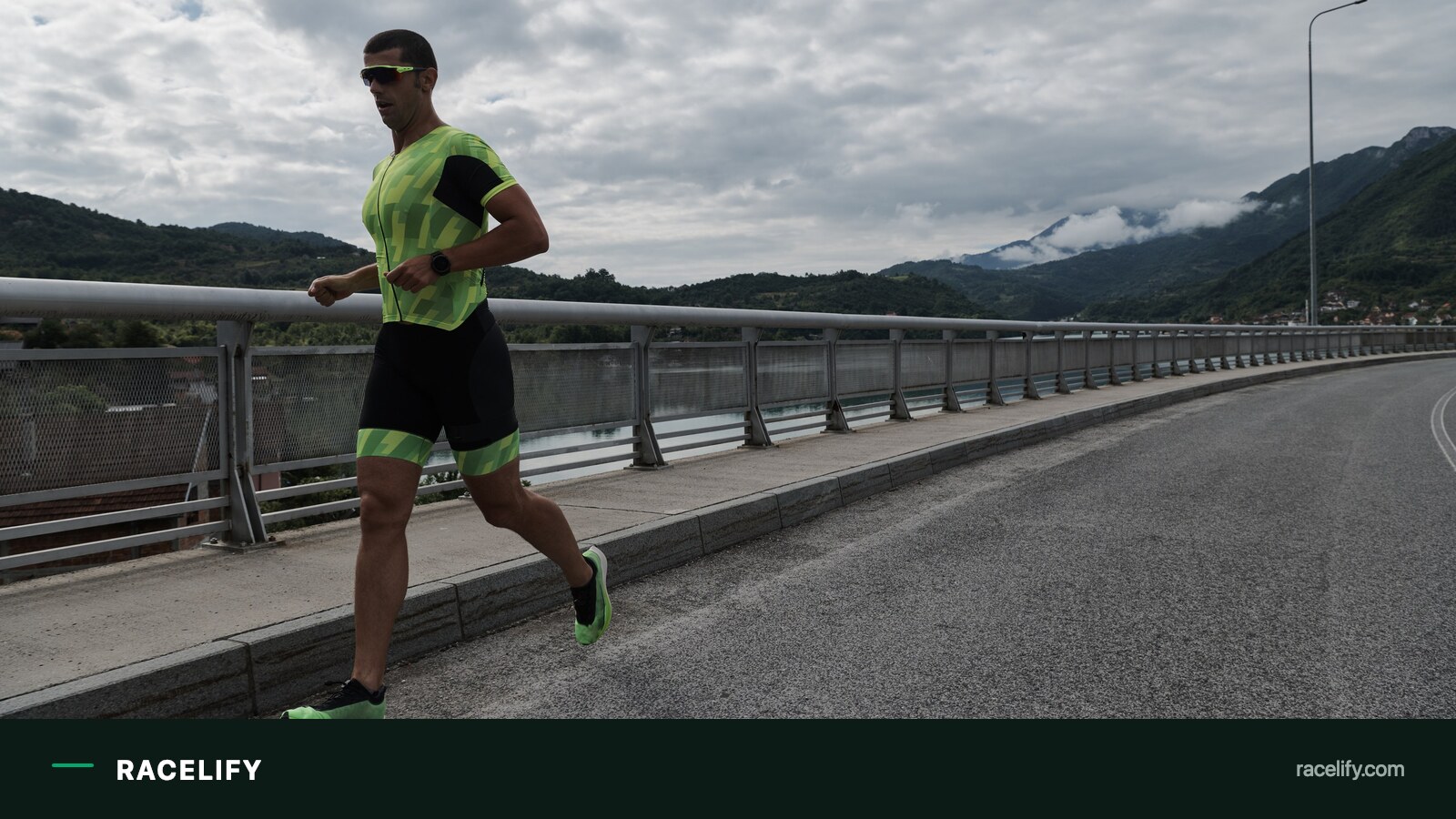
You’re on the start line. Goggles on for the hundredth time, but the strap never sits the way it does at the pool. The bike: you built it out of the travel box and did a couple of loops round the block, but you’ve never done that in a wet wetsuit, with the PA blaring and a few hundred other athletes around you. A bottle mounted between the aerobars, except how much did you actually drink from that setup in training?
This is exactly the problem race-simulation training is meant to solve.
What a Simulation Session Is, and Why It Matters
A simulation session is a workout where you deliberately recreate the conditions and sequence of race day: the swim exit, T1, the bike, T2, the run. It’s not about covering the full race distance, that’s what your A-race is for. It’s about reprogramming your nervous system so that nothing on race day feels new.
There are three benefits:
- You test tactics and pacing before there are real consequences
- You test gear and nutrition under real conditions, not just in your head
- You build confidence: you’ve done this before, and you know you can handle it
When to Schedule a Simulation Session
The ideal is twice per training block: one session about 8 weeks before the race, a second about 4 weeks before. The first is reconnaissance, you find out what isn’t working and what needs fixing. The second confirms you’re ready.
What not to do: don’t schedule a simulation the week before the race. You need 5 to 7 days to recover from a session like this, and taper week is not the time for new experiments.
Structuring a Simulation Session (Olympic Distance)
Swim: 500 to 750 m
Instead of just swimming the distance, recreate the effort pattern of the race:
- 100 m at start pace (the opening metres of a mass start can get chaotic)
- 200 m at settling pace (moderate effort, finding your rhythm)
- 100 m hard (simulating a sprint to a buoy or the finish)
- Short rest, repeat
One key drill: stripping off your wetsuit. Do it under time pressure, twice, with people watching if you can arrange it.
Bike: about 30 to 40 km
A format TrainingPeaks recommends for Olympic distance:
- 4 x 2 km at race pace-plus (slightly above your target FTP%)
- 8 km at base pace between intervals
- No breaks between blocks, ride it continuously, the way you would on race day
Non-negotiable: eat and drink exactly what you plan to use on race day. Not a simulation of your nutrition, the real thing: the same gel, at the same point on the course, that you’ll use on race day.
Run: 5 to 10 km
Run it straight off the bike. That’s the whole point of the exercise.
- 5 x 1600 m at race pace, with 400 m jog recoveries
- Run the first 800 m purely by feel, without looking at your watch. Your legs lie about pace after the bike.
What to watch: how far off your target pace is that first kilometre. If you’re starting too fast, that’s something to fix before race day.
What to Test During the Simulation
Some things seem obvious and only fail on race day:
Goggles. Do new ones slip on a run-in start? If you haven’t been in the water with them 10-plus times, you’re carrying a risk.
Cleats. Jumping into your shoes with cleats already clipped to the pedals, or putting shoes on standing beside the bike. Do it at least five times before the simulation.
Race number. How are you fixing it? Pins, elastic, a belt? Does it stay straight through 10 km of running?
Running cap. Does it stay on during the run.
The Mental Side: The Invisible Piece
A simulation session is also a mental exercise. Start the clock, set yourself a race target, and go. Watch what happens in your head once the pace gets hard.
Feel the pressure? Good, that’s where the learning happens. Every hard 200 metres of a simulation session is a rehearsal for the real race.
Don’t avoid discomfort in these sessions. You need to learn that you can handle it, and that means being in a hard place at least once before race day.
Two Sessions per Block
Eight weeks out: reconnaissance, diagnosing weak points. Four weeks out: confirmation that you’re ready, the sharp point of the season.
Each session costs 2.5 to 4 hours. In return: a calm start, gear you’ve already tested, and a head that knows it’s done this before.
This sits alongside How to Start Triathlon Training: A Beginner’s Guide. Racelify lists triathlons worldwide by date and distance.