
Canyon Predict: AI, Radar and a Bar-Mounted Screen
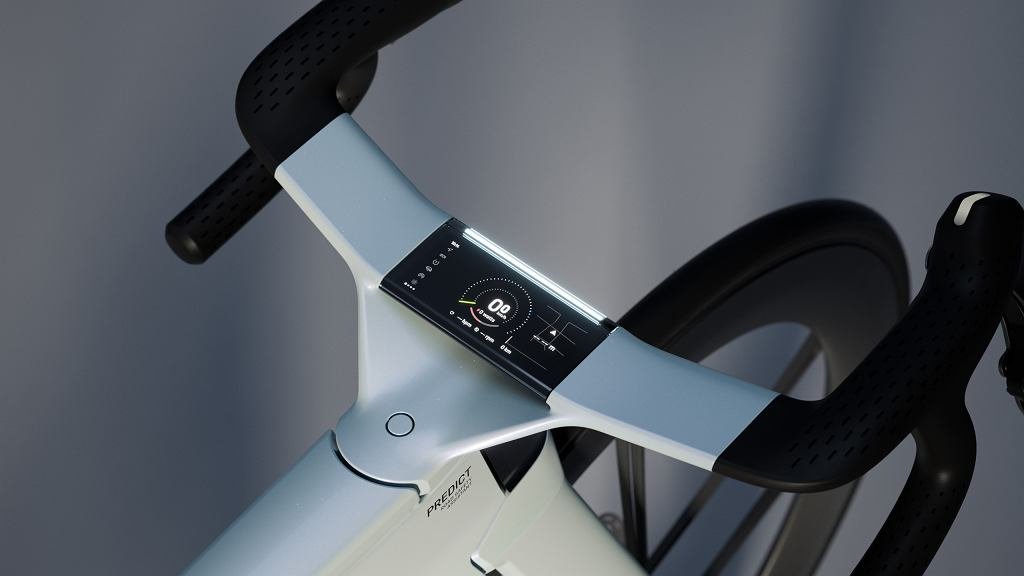
At Eurobike 2026 in Frankfurt, Canyon showed something that looks like it rolled in from a different decade. The Canyon Predict is a prototype, a concept nobody can buy, but the premise behind it is serious: a bike built to see what the rider cannot. Radar, cameras, onboard AI processing and a display built into the handlebar. Here is what is real and what is marketing.
What it actually is
Canyon calls Predict an intelligent system architecture for a road bike. Instead of reacting after the fact, the system is meant to predict hazards before the rider notices them. It does this through a 360 degree sensor array: four cameras and four radar sensors, three at the front and one at the rear, plus distributed sensors including a multi dimensional motion sensor built into the wheel hub, co-developed with DT Swiss.
All of it sits inside a premium road bike with a data screen integrated into the handlebar. The bike can also pair with the Stingr Smart augmented reality helmet, which has a drop down visor and its own display. It reads more like a fighter jet HUD than a road groupset.
Edge AI, the brain on the bike
The most technically interesting part is how it processes data. Instead of sending everything to the cloud, which adds latency and raises privacy questions, Predict runs entirely locally on the bike using Edge AI. Decisions happen instantly, without depending on an internet connection or sending the rider’s route to someone else’s servers.
The system combines camera footage, radar signals and the rider’s own data: speed, handlebar angle, stability. It uses that to build a model of the situation, predicts the rider’s trajectory and the trajectories of nearby objects, assigns each a risk score, and communicates it through directional lights, haptic feedback and prompts on the display.
There is even a hardware intervention: in a critical situation, the system can remotely retract the dropper post, lowering the rider’s centre of gravity and improving stability before a crash happens.
Why Canyon is doing this
Safety is the pitch, and Canyon cites hard numbers. According to the German statistics office, Destatis, one in six people, 16.4 percent, killed on German roads in 2025 was a cyclist, and cyclist deaths are up more than 20 percent compared with 2015. The European Transport Safety Council reports that 1,926 cyclists died on EU roads in 2024, and 65 percent of those fatal crashes involved a motor vehicle.
Canyon’s head of design, Fedja Delic, put it this way: cars have gotten safer, while riding a bike on the road has arguably gotten more dangerous than ever. Mazen Jrab, who leads the company’s IoT hardware, added that road cycling needs a safety revolution. It is a smooth marketing line, but the data backs the claim.
What this means for triathletes
Here is the catch: Predict is a road bike concept, and Canyon has not announced a time trial or triathlon version. But apply the same logic to the aero position. On a TT bike the field of view is limited, head down, eyes forward, almost no mirror checks. The speed gap between a rider on a fast time trial and an oncoming car can be enormous, and reaction time is a fraction of a second.
A rear radar is already standard kit, Garmin Varia among others, but Predict goes further by adding prediction and prompts inside the rider’s field of view. For someone training alone on Poland’s roads, that extra layer of awareness would be valuable. It is a direction, not a product, but a sensible one.
Verdict
Predict is a prototype, not a launch. There is no price, no date, and no certainty about how much of this ever reaches a showroom. Canyon has only said it will explain how and when these features might become mainstream. Treat it as a preview of a direction, not gear to add to a cart.
It is still a good preview. Radar with genuine hazard prediction, local processing instead of the cloud, and hardware intervention instead of a beep: if even part of this reaches production bikes in the coming years, riding on busy roads gets safer. That is the point of the whole exercise.