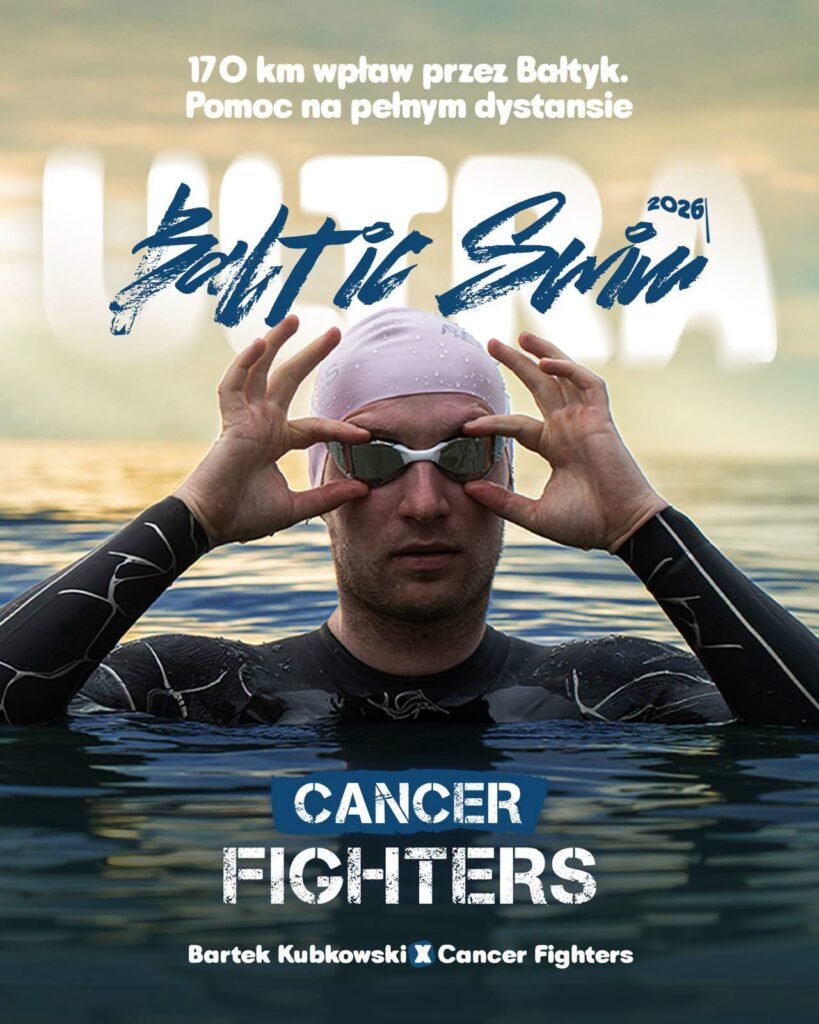
Ultra Baltic Swim 2026: Kubkowski swims Sweden to Poland
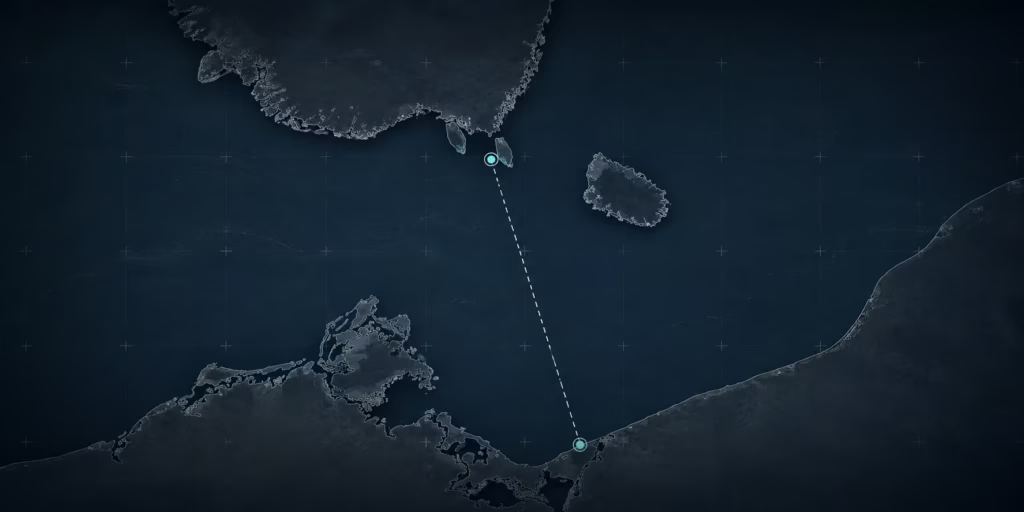
When Bartłomiej “Foka” Kubkowski walked out onto the beach at Dziwnowo, on Poland’s Baltic coast, under his own power at around 20:30 on Sunday evening, 2 August 2026, everyone on the shore was in tears. After nearly 55 hours of unbroken effort in the black water of the Baltic Sea, he became the first person in history to swim from Sweden to Poland. Roughly 160 kilometres, though some accounts put it closer to 170 km because the currents lengthened the distance actually covered, done at the fifth attempt, announced as “Last Dance”.
It was not a one-man show. Karolina Szczepaniak started from Sweden in the same weather window, a two-time Olympian (Beijing 2008, London 2012). She spent 58 hours in the water. Extreme exhaustion and heavy chafing led her crew to make the hard call to stop the attempt before she reached the Polish shore, but her swim goes into the history of Polish ultra-swimming regardless. She showed a resilience that carried thousands of people who were following her.
Rather than add another round of general congratulations, it is worth breaking the weekend down. Here is what sat behind the project physiologically, in equipment terms and logistically.
Physiological hell: face, hands and head after two and a half days at sea
Spending more than two days in high-salinity water at an open-sea temperature of 16-18°C wrecks the human body.
- Skin maceration: after that long in continuous immersion, skin loses its protective barrier. It soaks up water, goes soft as paper and gives way to the smallest injury. Swimmers’ hands and feet after attempts like this are wrinkled and bleached white, and even the touch of a towel hurts.
- Damage to the mouth and eyes: constant contact with sea salt swells the face. Eyes sting and fog up behind goggles despite the seal. The worst of it is breathing in salt spray and swallowing water by accident. After many hours the tongue and throat can swell enough to make eating anything a torture.
- Sleep deprivation and hallucinations: close to three days without sleep, combined with the monotony of black water, throws off the sense of balance. In 2025 Bartek was pulled out of the water 11 km from the Polish shore after more than 50 hours of effort. He had lost his bearings and was close to losing consciousness, so his crew ended the attempt. This year the key was surviving two full nights on open water without losing contact with reality.
Equipment: what do you swim the Baltic in?
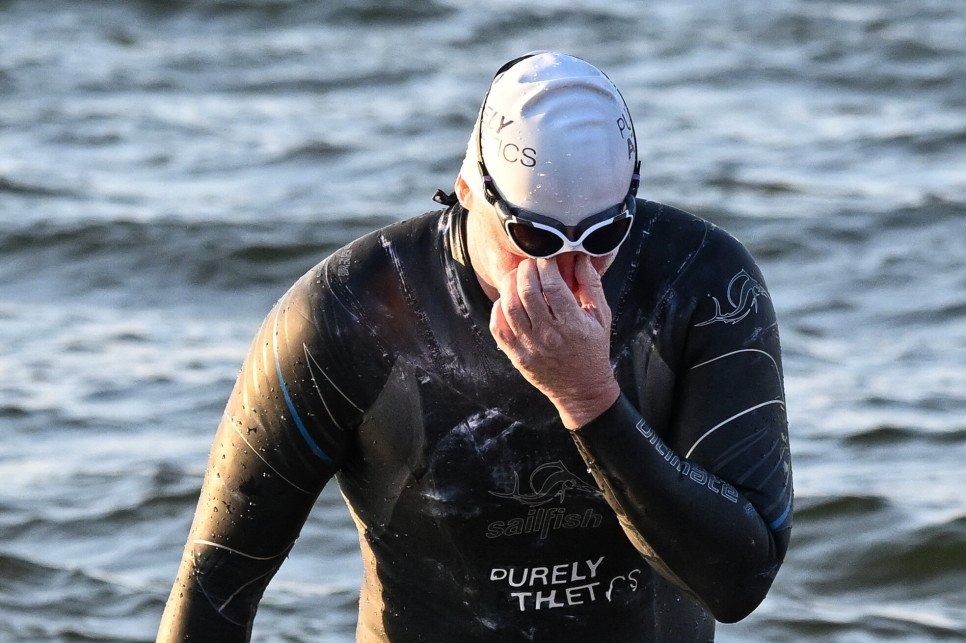
Under Ultra Baltic Swim rules a neoprene wetsuit is allowed, and it is the basis of survival. What the swimmer may not do, at any point, is touch the support boat. Bartek swam in a sailfish wetsuit, visible in the photographs from the finish at Dziwnowo. The pressure points, neck, armpits and groin, are usually covered in a thick layer of protective grease so the wetsuit seams and salt crystals do not wear the skin down to raw flesh. That is standard practice among long-distance swimmers, not something specific to the Baltic. He used dark-lensed goggles for the crossing, and a lifeboat crew watched over him around the clock.
Caloric hell: how do you feed a man who cannot stop?
The constant arm work is only part of the energy cost. Most of it goes on thermoregulation, on fighting hypothermia and generating heat to hold core temperature. According to media reports Kubkowski burned around 55,000 kilocalories during the crossing. Everything was passed to him from the boat without him touching it, as drinks and food handed over on a pole.
More than sport: over 800,000 złoty (about €185,000) raised
The effort had a purpose beyond the swim from the start. Kubkowski swam for the beneficiaries of the Cancer Fighters Foundation, which supports children and adults being treated for cancer. Alongside the sporting record, the one that mattered most fell too: the dedicated fundraiser on the foundation’s site passed 800,000 złoty (about 214,000 USD) and is still climbing (as of 3 August it stood at roughly 780,000 złoty, about 208,000 USD). Conversions use the National Bank of Poland rate of 3.7468 złoty to the dollar, table 149/A/NBP/2026 of 4 August 2026.