
Lactate gels from the Tour de France: what research shows
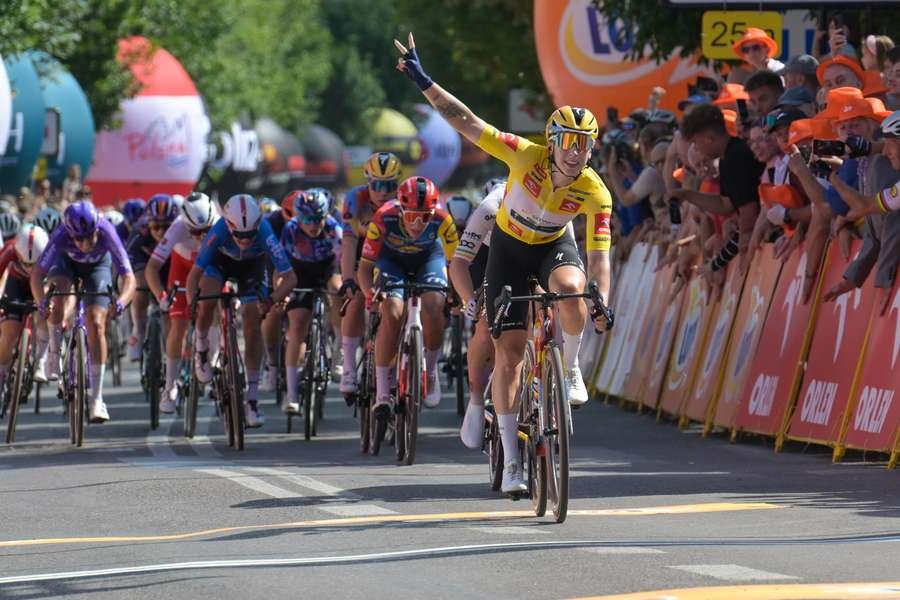
The peloton of the Tour de France 2026 rides into another mountain stage, and a soigneur from UAE Team Emirates-XRG hands Tadej Pogačar a bottle with something new in it. It doesn’t only contain glucose and fructose. It also contains lactate, a compound athletes were taught for decades to avoid, and which is now being sold as fuel.
This isn’t a forum rumour. Enervit and its rival From Lab to Field have officially confirmed testing lactate gels and drinks during this year’s Tour. It’s the question every amateur triathlete asks: does this actually make sense for them, or is it another fad that will vanish from the shelves as fast as it appeared?
What lactate actually is as fuel
Forget what you were taught in PE class. Lactate, lactic acid in its dissociated form, is not waste that “acidifies” muscles and needs to be “flushed out” with a jog. This is established physiology, confirmed for decades: the lactate shuttle theory, developed by Prof. George A. Brooks of UC Berkeley, shows that muscles, the heart and the brain use lactate as an energy source in real time, during exercise. This isn’t speculation, it’s textbook exercise physiology.
The novelty isn’t the knowledge about lactate itself. It’s the attempt to deliver it externally, in a form the body can actually use without triggering a stomach disaster. A standard carbohydrate gel has a natural ceiling: glucose enters the bloodstream through a single intestinal transporter, and above 60g/h it stops giving any extra benefit. Adding fructose, which uses a different transporter, raises that ceiling to 90-120g/h, and that’s the basis of today’s carbohydrate gels. Lactate manufacturers claim it enters through a third, independent pathway, so in theory it could push that energy limit even higher. In theory, and that word does all the work here.
Who’s testing it, and what’s actually in it
Two specific products are circulating at the Tour, not one.
| Product | Manufacturer | Contents per serving | Who’s testing it | Availability |
|---|---|---|---|---|
| ExoLactate | From Lab to Field (FLF) | 40g carbohydrate (1:1 glucose:fructose) + 5g exogenous lactate | Unnamed WorldTour team (under confidentiality) | On sale after the Tour de France 2026 ends |
| Enervit C2:1PRO Lactate Gel Mix | Enervit | 90g carbohydrate (2:1 glucose:fructose) + 10g sodium lactate + vitamin B1 | UAE Team Emirates-XRG (Tadej Pogačar) | On sale after the Vuelta a España 2026 (September) |
ExoLactate is the result of seven years of work by Aitor Viribay, a doctor of exercise physiology and former head physiologist at Ineos Grenadiers, now working in performance at Salomon. Enervit, meanwhile, doesn’t use its product routinely on every stage. UAE Team Emirates-XRG’s nutritionist, Gorka Prieto-Bellver, told Cyclingnews plainly: “we use it when it’s needed, not always… on stages where energy expenditure is high.” That sounds reasonable enough, since the team itself admits it’s still testing rather than running a proven protocol.
What the research confirms, and what is marketing
This is where physiology needs to be separated from sales.
Prof. Brooks, whose years of research Enervit built this product on, called C2:1PRO “a breakthrough that starts a new era in sports nutrition.” That’s a quote repeated in the manufacturer’s promotional material, not a conclusion from an independent clinical trial. Worth keeping those two things apart.
The actual research says little, and what exists is mixed. A randomised, double-blind crossover study from 2024 (Ewell et al., published in Nutrients) was not conducted on professionals: it involved 15 recreationally active people with an average age of 24, and the authors note that none belonged to the elite. Calcium and magnesium lactate supplementation didn’t change VO2peak, lactate threshold or ventilatory threshold. It recorded a 4 percent increase in average power over a 20-minute time trial, with no change in heart rate or perceived exertion. That’s a signal, but from a small pilot sample of amateurs, not proof for a professional.
A second 2024 study (Bordoli et al.) went the other way and involved 16 trained cyclists, at a higher dose of about 120mg/kg of body weight, roughly 8g for a 70kg (154lb) rider. Across five repeated blocks with 1km and 4km trials, it showed no time benefit at all, even though it raised blood bicarbonate levels and lowered perceived exertion. A 2025 study from the University of Tokyo (Seike, Takahashi, Hatta) confirmed that the body metabolically uses orally administered lactate, but it also found no breakthrough in performance.
The shared conclusion from these three studies: exogenous lactate works mostly as a mild acid-base buffer, similar to the already familiar sodium bicarbonate. It reduces perceived exertion and changes blood chemistry, but doesn’t reliably produce a measurable time advantage. Olav Bu, head of performance at Uno-X Mobility, is even more reserved in comments to Cyclist magazine: lactate delivers less energy than glucose for a similar absorption cost, and his team’s own research hasn’t yet found a “hard ceiling” for exogenous carbohydrate oxidation. Until that ceiling is established, lactate remains a less efficient fuel than what’s already known.
Gut tolerance: promising, but not independently confirmed
Manufacturers and some riders report that the new formulations, in ExoLactate’s case at a dose of 15-25g of lactate per hour, cause less gastrointestinal irritation than earlier, prototype versions of lactate supplements. That matters, because previous attempts at oral lactate had exactly this problem: it was hard to absorb a meaningful dose without stomach pain during exercise.
It’s worth being precise here, though: these are reports from the manufacturer and athletes at the race, not the result of a controlled study on gut tolerance under race conditions. No such study exists for this specific formulation. Lactate is, however, a substance the body produces naturally, so these products aren’t on the prohibited substances list. That’s one of the few things here that can be stated without qualification.
What this means for you as an amateur
Neither of these products is available for normal purchase yet. ExoLactate will reach the market after the Tour de France 2026 ends, Enervit C2:1PRO after the Vuelta a España, in September. Neither manufacturer has released a retail price yet, so there isn’t one here either. Don’t guess at it based on comparisons to gels like Maurten.
Before you trade a proven carbohydrate gel for something with lactate, it’s worth remembering: the strategy of 90-120g of carbohydrate per hour in a glucose-fructose mix has decades of research and years of race testing behind it. Lactate has three small, contradictory studies behind it and an enthusiastic quote from a press kit. That doesn’t mean the topic is meaningless, since Aitor Viribay spent seven years on this and UAE Team Emirates-XRG wouldn’t be testing it without reason on cycling’s biggest stage. It means that, for now, this is an elite experiment, not a protocol ready to copy for your next half-distance race.
If this topic intrigues you, watch what appears after September, and don’t try anything new for the first time on race day. That rule applies to lactate even more than to an ordinary gel, since there’s far less data on its tolerance under race conditions.
This sits alongside Alpe d’Huez 2026: Steger Wins, Siffert Completes Hat Trick. Racelify lists triathlons worldwide by date and distance.