
How Much You Actually Sweat: Stop Guessing, Test It
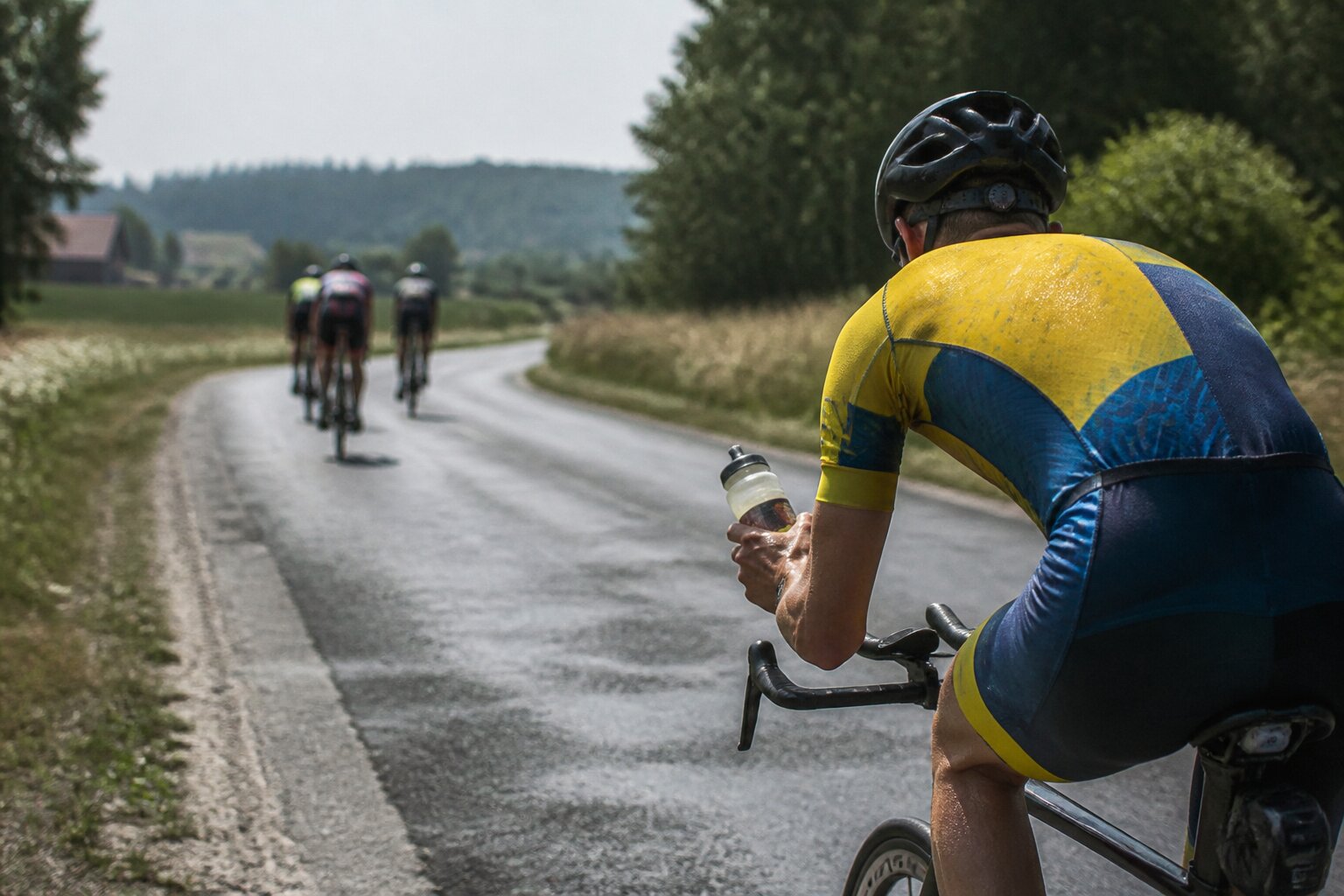
“Drink when you’re thirsty” is fine advice for a walk, not for a three-hour ride in July. In summer, overheating and dehydration can take a rider down in the second half of a session faster than a lack of fitness will. The trouble is that most amateurs drink by feel, either too little or too much as a safety margin. There is a simpler way: measure what you are actually losing. All it takes is a bathroom scale and one session.
Why feel gets it wrong
Sweat rate varies a great deal between individuals. Research shows it can differ several times over from one athlete to the next, and sodium concentration in sweat varies even more, by roughly a factor of ten. In trained endurance athletes, sweat rate during exercise usually falls between 0.5 and 2.0 l/h, and in heat some athletes reach as much as ~2.5 l/h. That means a training partner’s hydration plan can be completely wrong for someone else.
The stakes are real. Losing just 2% of body mass through sweat can hurt endurance, coordination and concentration. At 75 kg that is only 1.5 kg, roughly an hour of hard riding in heat without drinking. That is why the answer is to measure, not guess.
The sweat rate test, step by step
All that is needed is a scale, ideally accurate to 0.1 kg, and one session in conditions close to race day: similar temperature, intensity and discipline.
- Weigh in before the session, naked or in underwear only, after using the toilet. Record the number.
- Train for 60 minutes at a steady intensity. Track exactly how much fluid you drink, in grams or millilitres, since 1 ml is roughly 1 g.
- Do not use the toilet during the session. If you have to, the test is invalid, repeat it another time.
- Towel off and weigh in again, naked, immediately after the session.
Now the calculation. The formula is simple (mass in kilograms, and 1 kg of loss is roughly 1 litre of sweat):
Sweat loss per hour = (mass before − mass after) + fluid drunk
An example: starting weight 75.0 kg, after an hour 74.1 kg, with 0.5 l of water drunk along the way. That is 0.9 kg of mass lost plus the 0.5 l that passed through and evaporated. Sweat rate comes out to about 1.4 l/h, the amount that genuinely needs replacing for every hour in similar conditions.
One technical note: 1 kg of body mass lost is roughly 1 litre of sweat. That is a simplification, it does not account for fuel consumed or losses through breathing, but it is accurate enough for setting bottle strategy.
Sodium, the other half of the equation
Water alone is not the whole story. Sweat also carries away sodium, and here the gap between individuals is largest. A “salty” athlete, visible as white streaks on a shirt after training, needs far more electrolytes than someone who sweats “sweet”.
A home weigh-in test gives litres, but it will not give sodium concentration. That requires a sweat patch analysis or a professional test, offered by companies such as Precision Fuel & Hydration among others. Without a lab test, go by observation: heavy white residue on the face and clothing means reaching for stronger electrolyte drinks and tablets, especially for races longer than 2 hours in the heat.
Turning it into a bottle plan
Once sweat rate is known, the plan is simple:
- Target: no more than 2% of body mass lost during the effort. This is not about matching drinking litre for litre, a small deficit is normal and safe.
- Spread drinking across the whole session rather than gulping at the end. Small sips every 10 to 15 minutes absorb better than half a bottle at once.
- Scale it to race distance. At a sweat rate of 1.4 l/h and a 3-hour half-distance bike leg, that is over 4 litres to replace on the bike alone. That is what needs to fit into bottles and aid stations, within what can realistically be drunk and absorbed.
- Repeat the test in summer and winter. Sweat rate rises with temperature and humidity, so a plan built in March will not hold up in July.