Short version: a case study from Karlyn Pipes’s coaching showed that a swimmer with a corrected catch swam 50 metres 5 seconds faster and 100 metres 8 seconds faster, with no change in fitness, purely from fixing the early phase of the stroke. It is one of the fastest gains you can make in the pool. It is called EVF, Early Vertical Forearm.
What EVF is
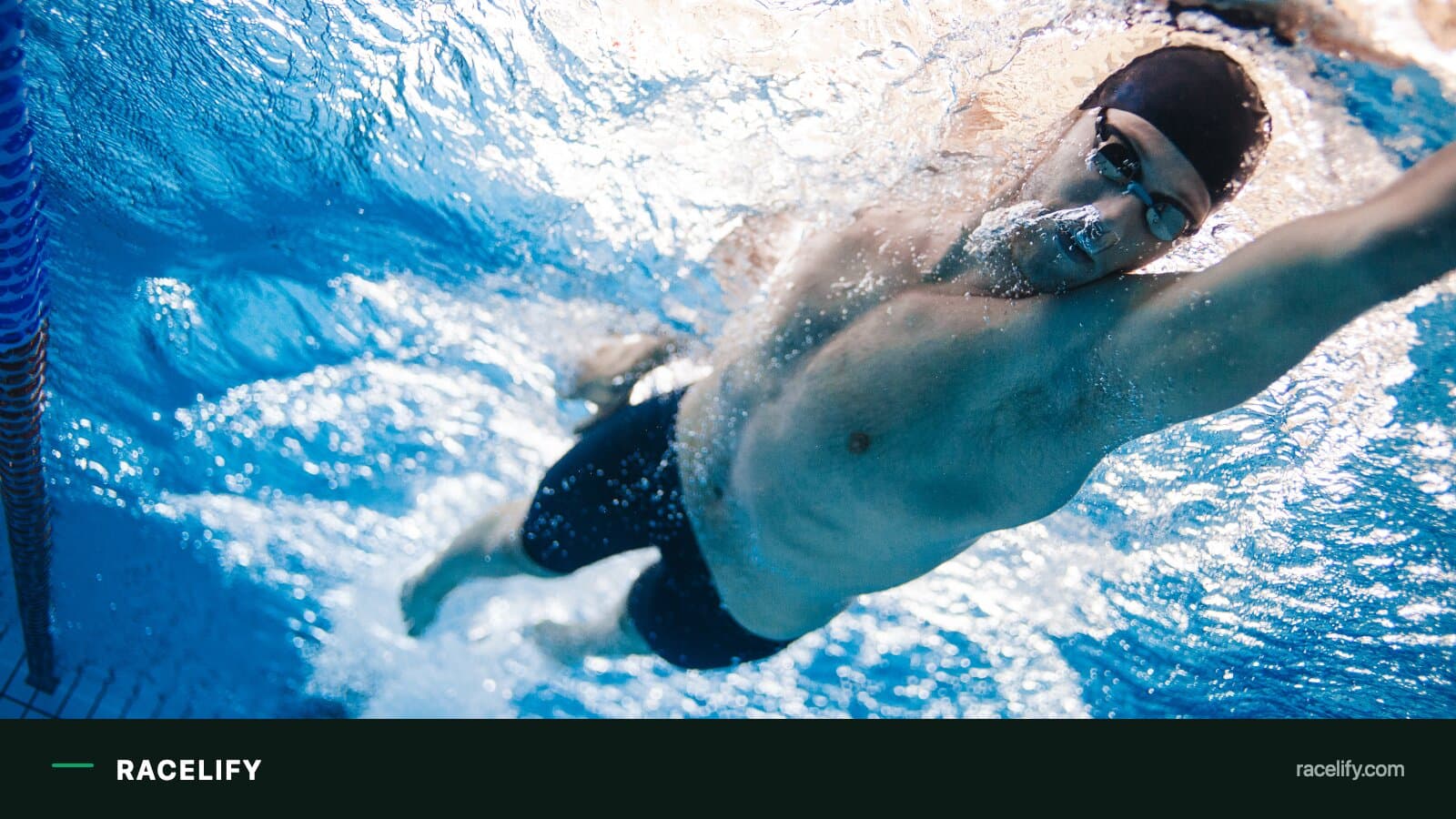
Early Vertical Forearm is the standard for modern freestyle technique. The mechanics are simple to describe and hard to execute: the elbow stays high, the forearm rotates down into a vertical position, and the whole hand and forearm work as a vertical paddle. The result is more surface area pushing water backward, a longer pull phase and less load on the shoulder.
Without EVF, with a dropped elbow, mostly the hand does the work. You lose 60 to 70% of your potential propulsive surface. The water slips past and you thrash harder to hold pace, the “swimming through a pot of coffee” feeling every triathlete hates after a run session.
Why this hurts triathletes especially
In freestyle, about 90% of propulsion comes from the arms, the legs generate only around 10% of thrust even in well-trained swimmers. Catch quality decides how efficiently you convert all that upper-body work into forward motion. In the pool you can mask a weak catch with tempo. In open water, in a wetsuit, tired after your warm-up, you cannot. That is why triathletes with a poor catch:
- Swim 1:45 per 100 metres instead of a possible 1:30
- Exit the water at the back of the group and lose the draft on the bike
- Burn 20 to 30% more energy over the same distance
What a correct EVF looks like
Picture the elbow “climbing” a wall. The hand enters the water slightly wider than the shoulder, about 5 to 10 cm, hand first, forearm following. The elbow stays near the surface and does not drop. By the time the hand is under the shoulder, the forearm should be close to vertical, with an elbow bend of roughly 90 to 100 degrees, the standard coaches teach.
The coaching mantra: “reach wide up front, pull short at the back.” The finish of the stroke is fast and strong. The whole motion works like a harpoon, not an oar.
Four drills that actually work
1. Catch-up drill
Push off the wall with both arms extended at shoulder width. Swim one stroke at a time, with the other hand waiting out front on the surface. This isolates the catch and pull phase for a single arm and forces you to keep the elbow high on purpose.
2. Doggy paddle
Hands stay underwater the whole time, no recovery above the surface. Perform a full catch and pull, one arm after the other, moving forward underwater. This builds a feel for the water’s resistance on the forearm. A pull-buoy between the legs keeps the focus on the arms.
3. Deck-up drill
Swim to the wall, place both hands on the pool deck, and pull yourself up while keeping your elbows high. This drill builds the muscle memory for the EVF position on land, where you can watch it clearly.
4. Reach full pull drill
One arm stays extended out front while the other performs a full catch and pull cycle. Hold a 2-second pause after each stroke with both arms extended. This isolates the mechanics from tempo, so the brain learns the correct position without the pressure of rhythm.
Dosage: two to three times a week, 10 to 15 minutes as a warm-up or cool-down. Do not build a whole session around technical drills. EVF needs to carry over into your main freestyle sets.
The most common mistakes
- Entering too wide. The hand lands outside the shoulder line and the elbow drops immediately. The hand should enter only about 5 to 10 cm wider than the shoulder, no more
- Pulling too early. Another EVF killer. Swimmers see “vertical forearm” and try to pull straight away. The elbow has to set high first, then the forearm rotates, and only then do you pull
- Pulling across the body. After the catch, the hand should pull straight back in line with the shoulder, not cross the midline
- Shoulder tension. If the elbow is fighting you, it is already too late. Start with technical drills using a pull-buoy to unlock the movement
How to check whether you have EVF
Filming from the side is the best test. Apps like TritonWear or MySwimPro, or just a GoPro on the pool deck, will show the elbow position during the catch. Alternatively, ask a training partner to watch from the side for 4 to 5 lengths. If the elbow sits clearly higher than the hand, you are in good shape. If the hand and elbow are at the same depth, there is work to do.
What this will not do
EVF is not magic. A week of drills will not turn fifth in your age group into second in the country. But 5 to 8 seconds per 100 metres is a real gain that plenty of swimmers reach after 4 to 6 weeks of consistent work. Over an IRONMAN 70.3 swim (1.9 km), that is 1.5 to 2.5 minutes less time in the water: a better group to exit with, a better draft, and less energy burned before the bike even starts.
Most triathletes still spend far more time on intervals than on technique. If your split is 0:100 in favor of intervals, technique work is the biggest gain still sitting on the table.
More on this: A Dry-Land Swim Warm-Up for When There Is No Pool. Racelify lists open water swims with dates and organiser links.