
Downhill Running: How Eccentric Training Protects Your Legs
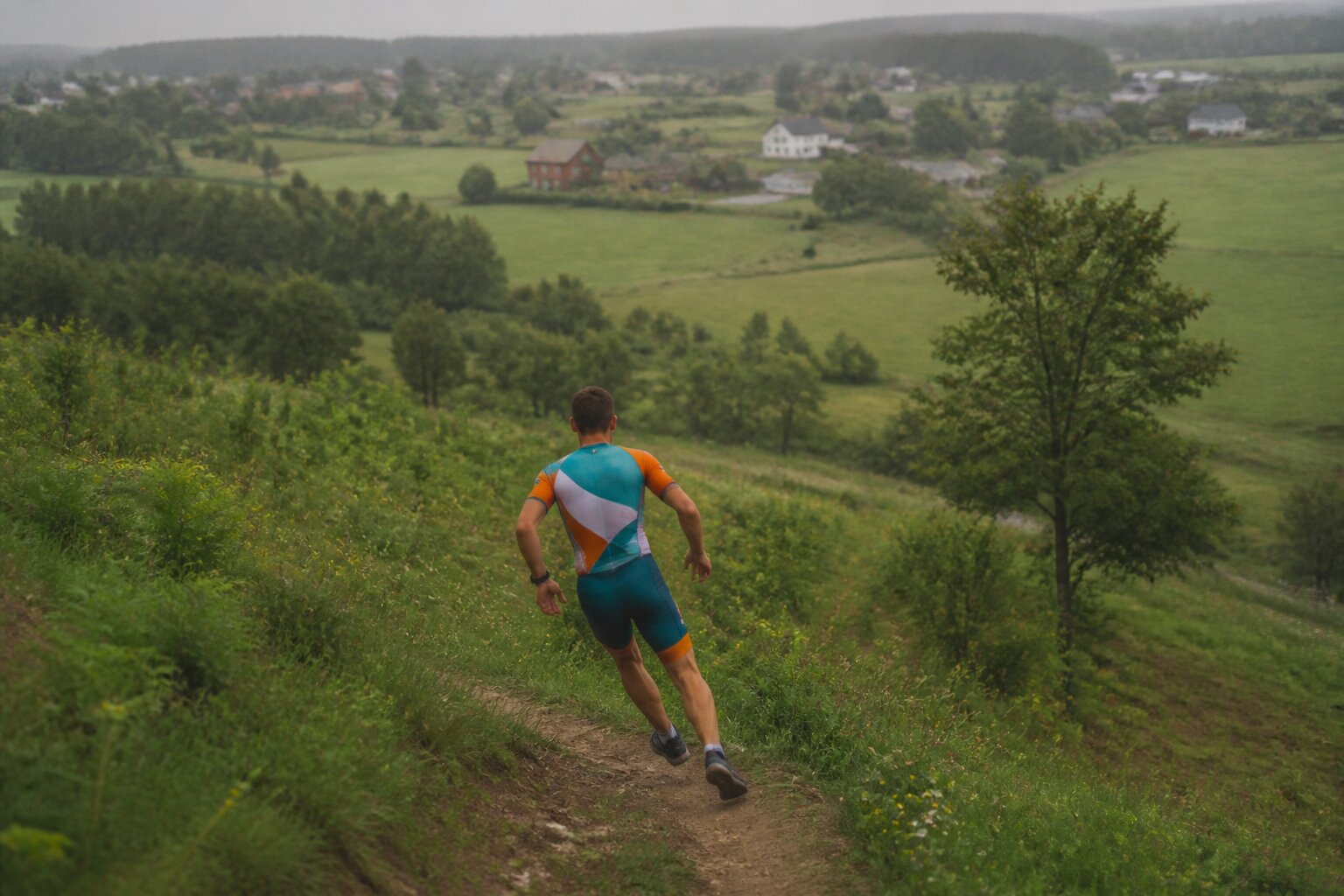
Anyone who has run a mountain half marathon or come off a bike on a hilly course knows the feeling: two days later the stairs at home hurt more than the race did. The uphills are not to blame. It is the downhills, and against intuition they do more damage to muscle. The good news: it can be tamed. One well planned session can protect the legs for weeks.
Why running downhill hurts more than running uphill
When running downhill, the quadriceps work eccentrically, lengthening under load to brake every landing. It works like engine braking instead of the brakes themselves. That kind of contraction generates high forces and leads to microscopic damage in the muscle fibres, known as EIMD (exercise-induced muscle damage).
The result is DOMS, delayed onset muscle soreness, which typically builds over 24 to 48 hours after the effort. One correction is worth making here, because the myth persists: DOMS is not lactic acid buildup. Lactate clears from the muscles within roughly an hour of training. Soreness after downhill running comes from mechanical damage and inflammation in the fibres being repaired, an entirely different process.
The price you pay: worse running economy
This is not just a matter of comfort. Muscle damage from downhill running measurably worsens running economy. At intensities above roughly 65% VO2max, more oxygen is needed for the same pace, though at lower intensities the effect can be negligible. For a triathlete this is a concrete problem: damage the legs on the bike descents and the run leg off the bike gets slower, even with the heart and lungs ready to go.
On top of that comes worse running mechanics, a drop in maximum strength, and greater reliance on anaerobic metabolism. In short: sore legs run at a higher cost and with worse form.
The repeated bout effect: a built-in vaccine
The body has a built-in defence mechanism: the repeated bout effect. One session of downhill running is enough for the next one, even after a long gap, to cause far less damage.
After a second identical session, studies record a smaller rise in creatine kinase, a marker of muscle damage, milder DOMS, less swelling, a smaller drop in strength, and better preserved running mechanics. The muscles learn to handle the load. The likely mechanism is more efficient motor unit recruitment and adaptation in connective tissue: the legs simply distribute force better.
The protection lasts for weeks. One solid downhill session a few weeks before a mountain race works like a vaccine: take a small dose of damage now to pay far less on race day.
How to work downhills in without them backfiring
The logic is simple: apply a controlled dose of damage well ahead of the race, not right before it.
- Timing: run the first downhill session at least 3 to 4 weeks before the main race with heavy descents. That gives the legs time to fully adapt.
- Dose carefully: start with a few short reps downhill on a moderate gradient, for example 6 to 8 x 60 to 100 m, controlled pace, soft landings. Do not jump straight into steep, long descents.
- Expect DOMS: legs will be sore for 1 to 2 days after the first session. That is normal, and it is the point. Plan easy days around it: swimming, gentle riding.
- Repeat after a week: the second session should hurt noticeably less. That is the sign the repeated bout effect has worked.
- Skip downhill running the week before the race. Freshly damaged muscle worsens running economy at exactly the moment speed matters most.
Technique matters too. Run with a slightly higher cadence and a shorter stride, and avoid braking with the heel planted far out in front. The softer the landing, the less force needs to be absorbed, and the less damage at the same speed.