
AI in Triathlon: Do Training Apps Understand Your Data?
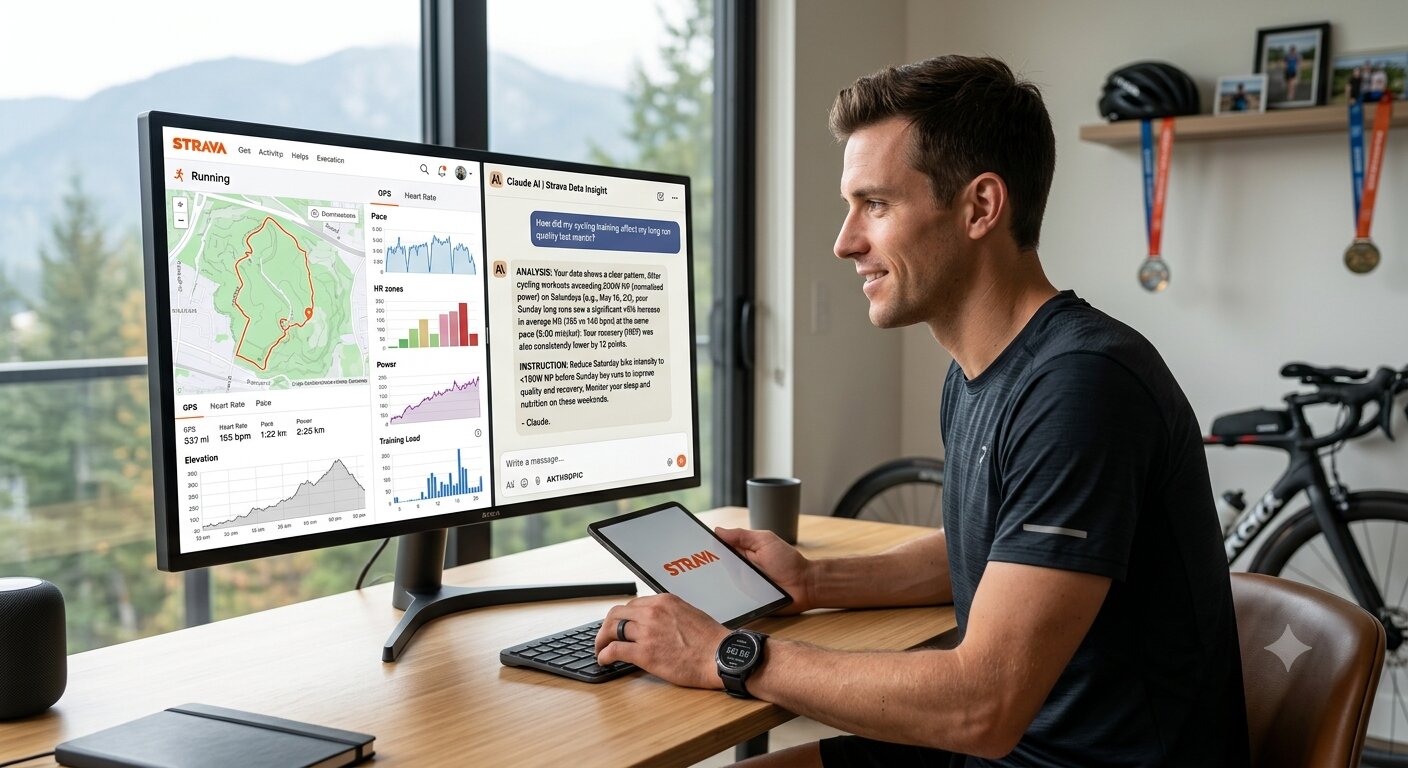
Not long ago, analysing training meant CSV exports, spreadsheets, manually comparing zones and long evenings spent over charts. Today more and more platforms try to make sense of it with artificial intelligence. The latest example is the Strava MCP Connector, an official link between Strava and Anthropic’s Claude assistant.
It sounds technical, but the idea is simple: instead of digging through your activity history yourself, you can ask an AI about your own training in plain language. Not generic advice from the internet, but answers drawn from your actual activities.
Strava MCP Connector: what actually happened
Strava launched its official MCP Connector on 1 June 2026. The tool is available to Strava subscribers and links a Strava account to Claude. Access is read-only, runs through OAuth authorisation, and can be revoked at any time in settings.
In practice this means Claude can analyse activity history, fitness trends, training load, GPS data, heart rate, pace and bike power. Strava stresses this is not a static data export but access to a user’s current account data.
Some example questions that start to make sense:
- Are my easy sessions actually easy?
- How has my pace changed on similar routes over the last few months?
- Does strength training or cycling affect my running?
- What did my heart rate look like on intervals during my last training block?
This is not yet an automatic coach that rebuilds an entire plan on its own. It is more of a very fast analyst that can read the data and pull out an answer without anyone copying charts by hand.
Why this matters for triathletes
Triathlon is an ideal sport for tools like this, because the data is everywhere. Swim, bike, run, intervals, heart rate, power, pace, sleep, HRV, fatigue, target race, taper. The problem for an amateur is no longer having too little data. It is having too much of it.
So the biggest shift is not that an athlete gets yet another app. It is that analysis stops being reserved for people who already know how to read load charts, power zones and heart rate drift.
If a system can answer, in plain language, why a Zone 2 run regularly finishes too hard, or why Sunday’s long run feels weak after Saturday’s ride, an amateur gets something valuable: faster feedback.
AI in triathlon: a quick platform comparison
The comparison below is not a ranking, since these tools solve slightly different problems. It is more of a quick map: what to pick if you want to analyse data, and what to pick if you want a plan that reacts to how training actually goes.
| Platform | Main use | Strongest point | Limitations | Indicative price |
|---|---|---|---|---|
| Strava MCP Connector | Analysing training history through Claude | Natural-language questions about your own data: heart rate, pace, GPS, power, load | Read-only access; at launch, integration is mainly with Claude | Part of a Strava subscription: $11.99 a month or $79.99 a year |
| Triathlify | Adaptive triathlon training plan | Planning for a race or for weight loss, daily adaptation, Garmin/Strava/Apple Health integrations, Polish-language version | A younger platform than the biggest global players; some integrations are still on the roadmap | 9.99 USD/month or 99.99 USD/year |
| TriDot | Advanced planning and result prediction | Extensive training engine, RaceX, plenty of data and race scenarios | Higher price; can be too much for beginners | from 14.99 USD/month; Essentials 39 USD/month; Complete 99 USD/month |
| Athletica.ai | Adaptive endurance plans | Simple subscription model, dynamic plan adjustment, sports-science methodology | Less triathlon-specific ecosystem than TriDot; more focus on general endurance sport | 19.90 USD/month or 189 USD/year |
Strava: a conversation with your own training history
How it works: the Strava MCP Connector lets you talk to Claude about your own training data. It is read-only, so the AI does not edit activities or upload new workouts to the account.
For now, Strava is launching with Anthropic’s Claude, but says it may support other AI clients in future. That matters, because MCP as a standard could eventually become more than one app’s single integration.
Who it suits: people with a long history on Strava who want to quickly find trends, dependencies or mistakes in their training, without exporting data by hand.
Price: the feature is part of a Strava subscription. According to Strava’s current pricing page, an individual subscription costs $11.99 a month or $79.99 a year. Prices can vary by payment channel, promotion and bundle.
Triathlify: adaptive triathlon training
How it works: Triathlify is a platform built for triathlon. Its premise is to adapt the plan based on session data, not just display it afterwards. The platform states it syncs with Garmin and Strava, works on a periodised plan from sprint to Ironman distance, and adapts daily based on completed load, calendar and recovery signals.
On its methodology page, Triathlify describes analysis of sleep, HRV, resting heart rate, wellbeing, adherence to the plan, CTL/ATL/TSB and phases of preparation. That matters, because in triathlon simply knowing “you did the session” is not enough. What counts is whether you did the right stimulus at the right moment.
Who it suits: athletes who want an adaptive triathlon plan, watch integration and the option to use the platform in Polish.
Price: according to Triathlify’s current pricing, the Athlete plan costs 9.99 USD a month or 99.99 USD a year. A 7-day trial is also available. So you can test all features for free.
TriDot: heavyweight and built on a predictive engine
How it works: TriDot is one of the best-known AI platforms in triathlon. The system is built on analysis of an athlete’s data, training history, race profile and environmental conditions. Among other tools, the platform uses RaceX Performance for forecasts and race optimisation.
This is a more built-out tool, and a pricier one. For some athletes it will be a great fit, especially if they like a heavily structured process. For others it may feel too heavy, or too rigid against everyday life.
Who it suits: triathletes who want a very advanced training platform and are willing to pay for the full ecosystem.
Price: TriDot’s current pricing starts with the Lifestyle plan at 14.99 USD a month. Essentials costs 39 USD a month, Complete 99 USD a month, and the Premium version with a coach starts from 249 USD a month.
Athletica.ai: microcycle adaptation and simple pricing
How it works: Athletica.ai focuses on adaptive plans for endurance sports. The platform analyses completed sessions, load and recovery-related signals, then adjusts the next sessions accordingly. Its strong point is a simple model: fewer pricing tiers, more focus on the planning itself.
Who it suits: athletes who want a dynamic endurance plan without a heavily layered, multi-tier system.
Price: 19.90 USD a month, 99 USD for 6 months, or 189 USD a year. New users get a 14-day trial.
What is worth asking the AI after connecting your data
Tools like this make the most sense once the questions get specific. Instead of asking “how should I train?”, it works better to ask something that can actually be checked against the data.
- Are my recovery sessions actually recovery?
- In which weeks did load rise too fast?
- Does run quality drop the day after a long ride?
- How has heart rate at the same pace changed over the last 12 weeks?
- Which sessions correlate best with improved fitness?
- Was the taper before the last race long enough?
Where is the catch
AI in training does not solve everything. A system can read heart rate, pace and power well, but it will not see poor swim technique, a badly fitted saddle, an overuse injury building up, or the fact that an athlete has been sleeping five hours a night for three weeks.
Data is only powerful when it is complete and well interpreted. The best scenario is not “AI instead of a coach”, but AI as a filter that helps spot a problem faster.
AI will not replace a coach. It can replace chaos
The important question is not “will AI replace a coach?”. That is too simple. A good coach still sees more than a chart: life context, stress, motivation, injury history, technique, the athlete’s head before a race.
But AI can replace something else: chaos. It can catch faster that easy runs are running too hard. It can notice that run quality regularly drops after a hard ride. It can show that a plan looks good on paper while the body has stopped absorbing it.
For an amateur training between work, family and everyday life, that can make a huge difference. Not because artificial intelligence knows everything, but because it does not get tired of looking at the data.
What is next
The Strava MCP Connector points at the direction the whole market is heading. Training data stops being just an archive of activities. It starts becoming material for conversation, analysis and decisions.
The platforms that win will not be the ones shouting “AI” the loudest, but the ones that turn data into a simple decision: train harder today, ease off today, shift emphasis today, you are ready today.
Anyone who wants to check how Strava describes its official connection with Claude can look at the documentation: Strava MCP Connector.
The future of triathlon will not be about getting even more charts. It will be about finally being able to read those charts fast enough to know what to do tomorrow.